
What Is Commercial Boiler Replacement?
Commercial boiler replacement means removing boilers that have reached the end of their working life from an existing plant room and installing new ones on the same heating system. Much of the plant that was installed in the 1980s and 1990s — cast-iron sectional boilers, atmospheric burners, open-flued floor-standing units — is still running in schools, churches, offices and blocks of flats, often at seasonal efficiencies well below what a modern condensing boiler achieves.
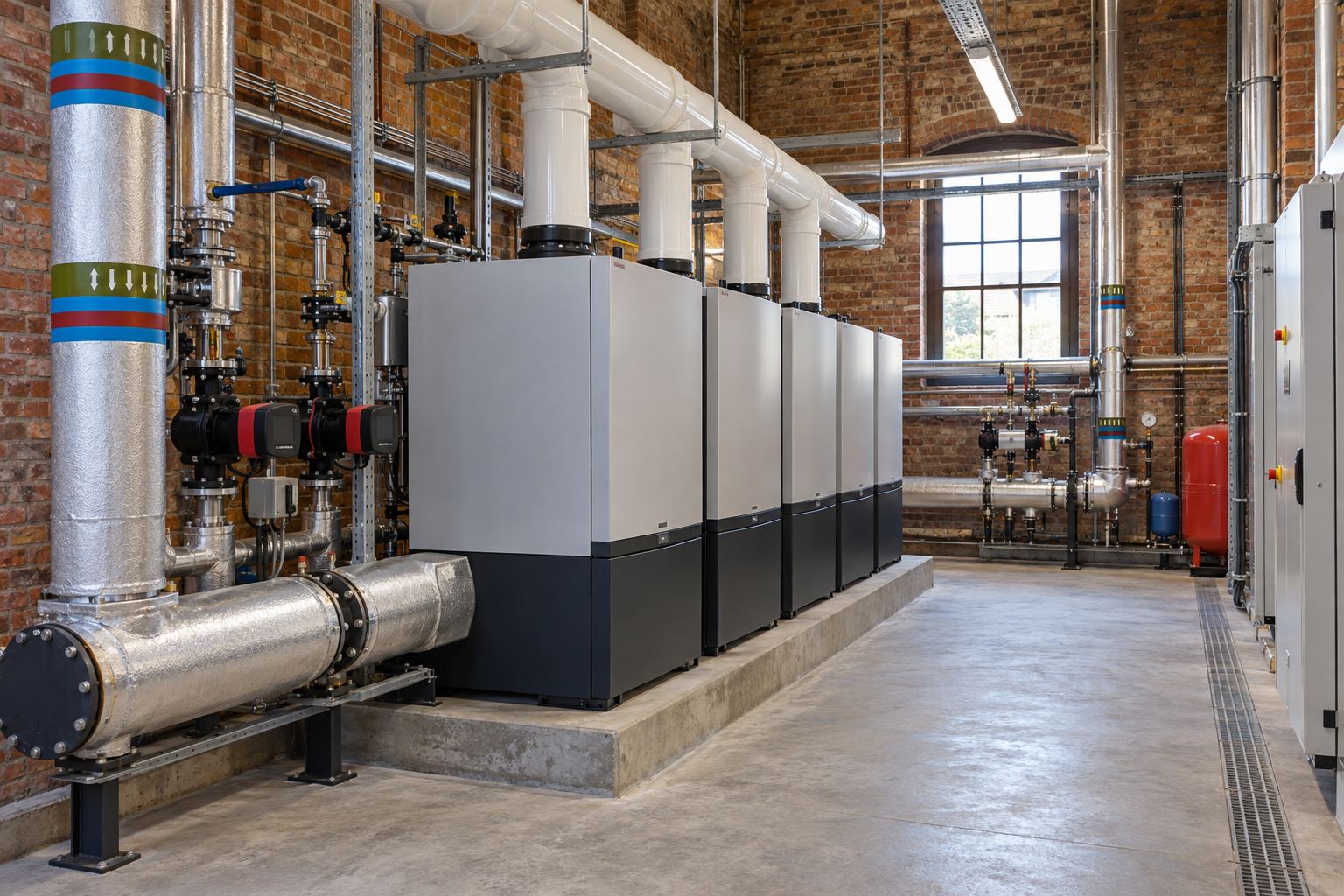
What makes a replacement harder than it looks is that the new boilers have to work with a system designed for the old ones. Condensing boilers need low return temperatures, a condensate drain, a different flue and usually protection from the dirt that decades-old pipework carries. A good replacement deals with those issues rather than simply bolting new boilers onto old problems.
Signs Your Commercial Boilers Need Replacing
- Spare parts for the burners or controls are discontinued and engineers are sourcing them second-hand
- Cast-iron sections have cracked or are weeping, and resealing has stopped working
- An engineer has issued an at-risk or immediately dangerous notice on one of the boilers
- Gas consumption is high compared with similar buildings, or an energy audit has flagged the plant
- Repair bills over the last two or three winters add up to a significant share of the cost of new plant
- The plant room still relies on a single boiler with no standby if it fails
Commercial Boiler Replacement Approaches Explained
- Like-for-like output, condensing plant — the old boilers are removed and replaced with condensing units of similar total output. Often the output can be reduced, because older plant was frequently oversized.
- Cascade conversion — one or two large floor-standing boilers are replaced with a frame of smaller wall-hung boilers, freeing floor space and adding standby capacity.
- Hydraulic separation — a plate heat exchanger is fitted between the new boilers and the old system, protecting the boilers from sludge and allowing the old pipework to stay at its existing pressure.
- Phased replacement — on multi-boiler sites, one boiler is replaced at a time so the building keeps some heating throughout.
Protect the new boilers from the old system
Before choosing a straight swap, ask for the condition of the existing water, pumps and distribution pipework to be checked. Sludge removal, filtration or a plate heat exchanger may be needed to protect new heat exchangers. Agree isolation points, temporary heating connections and the route for heavy sections out of the building.
What to Include When Asking for a Quote
Photograph the data plate on each existing boiler and send the make, model, output and approximate age, along with the flue arrangement — individual flues, a shared chimney, or a fan-dilution system. Say whether the boilers are open-vented or the system is pressurised, and whether there is a calorifier for hot water off the same plant. These details tell a contractor whether the flue, header and pumps can be reused or need replacing too.
Explain how equipment will come out and go in. Old sectional boilers are heavy and are usually dismantled in the plant room; a basement with a narrow stair or a rooftop boiler house without lift access changes the labour and lifting cost considerably. Mention whether asbestos has been identified in the plant room — lagging, flue rope and old gaskets are common — and whether an asbestos survey exists.
The quotation should state whether a system clean or plate heat exchanger is included, how condensate will be drained, what happens to the heating while work is under way, and who removes the old boilers. Ask whether the price assumes weekday working or includes weekend or holiday working to keep disruption down.
How Much Does Commercial Boiler Replacement Cost?
| Replacement scope | Typical cost |
|---|---|
| Single boiler swap, existing flue reused or relined | £6,000 – £12,000 |
| Two to three boilers with new header and flue | £12,000 – £25,000 |
| Full plant room strip-out, cascade, pumps and controls | £25,000 – £40,000+ |
Prices are usually quoted excluding VAT. Asbestos removal, crane hire, temporary boilers and building management system work are often priced as separate items, so check each proposal includes the same scope.
The Commercial Boiler Replacement Process: What to Expect
- Plant room survey. The engineer records existing plant, flue and pipework condition, confirms the load and checks for asbestos records.
- Specification and programme. New plant is selected, the shutdown period is agreed and any temporary heating is arranged.
- Isolation and strip-out. Gas, water and electrics are isolated; old boilers are drained, dismantled and removed.
- System preparation. The system is cleaned or separated with a plate heat exchanger, and the flue is replaced or relined.
- Installation. New boilers, header, pumps and controls are installed, gas pipework is tested and purged and condensate drainage is routed.
- Commissioning and handover. Boilers are fired and set up, interlocks and controls are proved, and you receive commissioning records and a gas safety record.
Building Regulations and Approvals
Replacing a commercial boiler is building work that must comply with the energy efficiency requirements in Approved Document L for non-domestic buildings in England, or the equivalent rules elsewhere in the UK. That includes minimum boiler efficiencies and controls. Ask the installer how the work will be notified. A new or altered external flue can need planning permission on listed buildings or in conservation areas, and larger plant may need chimney height approval from the local authority. Disturbing asbestos-containing materials requires the right survey and, where needed, a licensed contractor.
How to Choose a Commercial Boiler Replacement Contractor
- Have they replaced plant of a similar age and type, such as sectional cast-iron boilers?
- Do the engineers hold non-domestic gas categories for the appliances and pipework?
- How will they protect new condensing boilers from sludge in the existing system?
- Can they keep part of the building heated, or supply a temporary boiler?
- How do they deal with suspected asbestos found during strip-out?
- What warranty comes with the new boilers, and what servicing does it depend on?
Frequently Asked Questions
Can I keep the existing pipework and radiators when replacing commercial boilers?
Usually, yes. Most replacements reuse the existing distribution system. The contractor should check its condition and either clean it thoroughly or fit a plate heat exchanger so that sludge from the old pipework does not damage the new boilers.
Will the new boilers be smaller than the old ones?
Often. Older commercial plant was frequently oversized, and building improvements such as new windows or insulation reduce the load. A survey and load check can show whether a lower total output is enough.
How long will the building be without heating?
A single boiler swap can take two or three days; a full plant room replacement can take up to two weeks. Phasing the work on multi-boiler sites or hiring a temporary boiler can keep heating running.
Should commercial boilers be replaced in summer?
Where possible, yes. Replacing plant outside the heating season avoids cold buildings and gives time to deal with unexpected problems, but contractors are busiest then, so book the survey early.